The Pharmacy Squeeze: What Medicare Agents Need to Know
Your client's pharmacy may not be there next year, and the reason is how pharmacies get paid. Rite Aid closed its last stores in 2025. Walgreens went private in August 2025 and plans to close 1,200 of about 8,500 U.S. stores, with coverage citing "thin prescription reimbursement." Independent pharmacies say they are closing at a net rate of about one a day.
For Medicare agents, this is not just industry news. It changes which plan fits a client, it creates a conversation most agents never have, and it opens the door to one of the best referral relationships in your market: the local pharmacist.
The crunch: paid less than it costs to fill
On many Medicare prescriptions, what the pharmacy earns above the cost of the drug no longer covers the cost of filling it.
| Measure | Figure | Source |
|---|---|---|
| Cost to fill one prescription, national average (drug cost excluded) | $12.40 mean, $11.15 median | 2020 national cost of dispensing study |
| Cost to fill, Colorado 2024: chains vs independents | $12.14 vs $19.85 average | Colorado Medicaid survey |
| Cost to fill, highest-volume stores (110,000+ prescriptions a year) | $9.18 average | Colorado Medicaid survey |
| Gross profit per prescription, independents, all payers | $11.50 to $12.00 (2016 to 2020) | NCPA Digest via Drug Channels |
| Gross profit per prescription, 45 common Part D generics | $3.87 average, before PBM fees | JAMA Health Forum, 2023 |
| Pharmacy margin on retail drugs | 7% in 2020, 3% in 2022 | HHS ASPE, 2024 |
| Independents paid below drug cost on half or more of Part D claims | 29.2% of those surveyed | NCPA survey, Jan 2025 |
The gross profit is what is left after paying for the drug; the cost to fill is labor, rent and systems. When the first number is smaller than the second, the pharmacy loses money on the prescription. Scale helps, but even the most efficient chain store spends about $9 to fill one.
The squeeze is sharpest on Medicare. Commercial and cash prescriptions carry higher margins, so a pharmacy with many Medicare customers feels it most. Those are your clients.
Where PBMs fit
A pharmacy benefit manager (PBM) is the middleman a Part D plan, MA plan or employer hires to run the drug benefit, and it decides what the pharmacy is paid. It has three jobs:
Builds the pharmacy network and sets pharmacy pay for every fill.
Negotiates rebates with drugmakers in exchange for better formulary placement.
Processes the claim at the counter in real time.
It earns money by keeping part of the rebates, charging the plan more than it pays the pharmacy ("spread pricing"), collecting fees from pharmacies, and steering patients to pharmacies it owns. The FTC found the big three PBMs paid their own pharmacies more than outside pharmacies on nearly every specialty generic studied, earning over $7.3 billion above drug cost from 2017 to 2022.
Four insurer-owned PBMs process about 87% of prescription claims:
| PBM | Owner | Share of 2025 claims |
|---|---|---|
| Express Scripts | Cigna | 31% |
| CVS Caremark | CVS Health (Aetna) | 26% |
| Optum Rx | UnitedHealth Group | 23% |
| Humana Pharmacy Solutions | Humana | 7% |
That is the core conflict: the company setting a pharmacy's pay often owns a mail-order or retail pharmacy competing for the same customer.
The consumer's conundrum
The cheapest choice for your client today can weaken the pharmacy they will need tomorrow. Plans often reward 90-day mail order and preferred pharmacies with lower copays, and for stable maintenance drugs that saves real money. Every prescription that leaves the local counter, though, makes that store less likely to survive.
What mail order does well
Lower copays on maintenance drugs like blood pressure, cholesterol and diabetes medications.
Delivery for clients who struggle to get out.
A 90-day supply, which industry-funded studies link to better adherence.
What clients lose without a local pharmacy
Same-day fills for antibiotics, post-surgery pain medication and anything urgent.
A pharmacist who knows them and catches interactions across many medications.
Easy access to vaccines.
Quick fixes when a claim rejects or a prior authorization stalls.
The savings from mail order also do not always reach the client. When the PBM owns the mail-order pharmacy, it can keep both the PBM spread and the dispensing margin. The right answer depends on the client, which is exactly why they need an agent to ask.
Relief on the way
Real relief is now federal law, but most of it does not start until 2028 or 2029. The Consolidated Appropriations Act of 2026, signed Feb 3, 2026, includes these Part D reforms:
PBM pay delinked from drug prices starting Jan 1, 2028. PBMs can be paid only flat, fair-market fees for services.
Rebates passed through in full to Part D plan sponsors.
Any willing pharmacy: plans must let any pharmacy that accepts standard terms join the network.
"Reasonable and relevant" contract terms for pharmacies. HHS sets the standards by Apr 3, 2028, and they take effect Jan 1, 2029.
Essential retail pharmacies: a federal list of stores not owned by a PBM that are the only pharmacy within 1 mile (urban), 2 miles (suburban) or 10 miles (rural), starting Jan 1, 2028.
PBM reporting to plans and HHS, starting Jul 1, 2028.
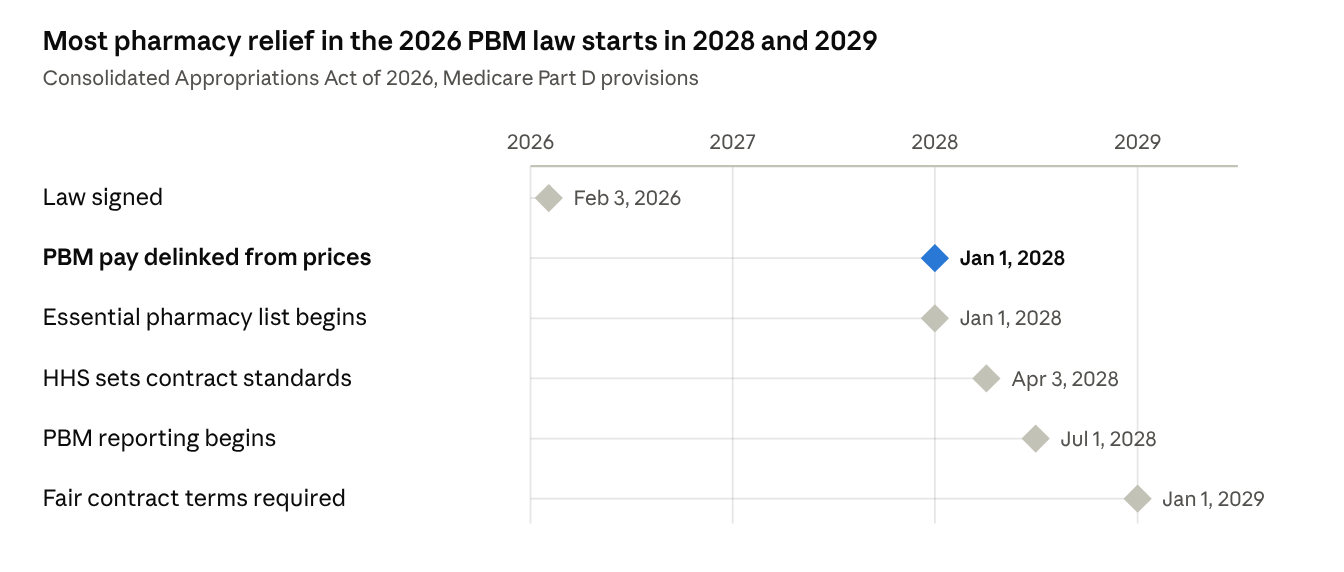
Consolidated Appropriations Act of 2026 milestones, per Barclay Damon summary. Every pharmacy protection in the law lands after the 2027 AEP.
Other relief is happening outside Congress:
Cost-plus pay: paying the pharmacy its drug cost plus a set dispensing fee near the real cost to fill. Many state Medicaid programs already pay this way, and CVS moved its own pharmacies to a cost-plus model called CostVantage.
State action: Arkansas passed a 2025 law banning PBMs from owning pharmacies in the state. A federal judge blocked it in July 2025 while the PBMs' lawsuit proceeds, and other states are watching.
The practical takeaway: the squeeze continues through at least the 2027 and 2028 AEPs.
How agents can help local pharmacists, and earn referrals
The agent who keeps a pharmacy's patients in plans that pay that pharmacy well becomes its most valuable ally.
Help the pharmacy with every enrollment
Ask every client where they fill and how. Make the pharmacy question as routine as the doctor question.
Check preferred status, not just in network. In Part D, a preferred pharmacy often means a far lower copay than a standard in-network one. Show the client the difference in Plan Finder.
Steer only where it fits the client. If a client relies on their pharmacist, put a plan where that pharmacy is preferred at the top of the list. If mail order truly fits, say so.
Watch the termination list. With more than 4 million people losing their MA or drug plan on Dec 31, every switch is a chance to check the pharmacy.
Build the relationship
Introduce yourself to local independent pharmacists outside AEP rush. Learn which plans they say pay them fairly and which they are dropping.
Ask what problems their Medicare patients bring to the counter: plan terminations, denied claims, surprise copays. Those patients need an agent.
Offer to be the person they send patients to with plan questions. Pharmacists are allowed to refer patients to plan marketing representatives.
Follow up on referrals with good service, then thank the pharmacist by keeping their patients in plans that work for the store.
Stay inside the rules
CMS rule 42 CFR 422.2266 sets clear lines for pharmacies:
No marketing at the pharmacy counter. Sales activities and materials are barred where care is given, including pharmacy counter areas.
Common areas are allowed. With the pharmacy's permission, materials can go in entryways and waiting areas.
Pharmacists can refer and inform. They may name the plans they contract with, discuss plan merits and refer patients to an agent.
Pharmacists cannot enroll or be paid. They may not take enrollment forms or Scope of Appointment forms, and may not be paid for marketing or enrollment.
The client calls you. Under 42 CFR 422.2264, calls based on referrals are unsolicited contact. Give the pharmacist your card to hand out; do not ask for patient names to call.
Never pay for referrals. Paying a pharmacy for patient referrals risks the federal Anti-Kickback Statute. Check Brock compliance and carrier rules before any thank-you to a referral source.
Get the free Medicare Bible
Part D rules and plan choices keep shifting, and the Medicare Bible keeps your fundamentals straight while they do. Download the free Medicare Bible.
Related reading:
Sources
CBS News: Sycamore Partners finishes deal to acquire Walgreens (Aug 28, 2025)
NCPA comments to CMS on Part D, with January 2025 pharmacy survey (Jan 27, 2025)
Abt Associates for NACDS, NASP and NCPA: 2020 Cost of Dispensing Study (Jan 2020)
Drug Channels: Five Things to Know About the State of Independent Pharmacy Economics (Feb 2022)
HHS ASPE: Pharmaceutical Supply Chain Intermediary Margins in the U.S. Retail Channel (Sept 2024)
FTC: Second Interim Staff Report on Prescription Drug Middlemen (Jan 2025)
Becker's: Top PBMs by 2025 market share (Drug Channels data)
Healthcare Dive: Judge halts Arkansas PBM pharmacy law (Jul 30, 2025)
KFF: More than 4 million Medicare beneficiaries will have their plan terminated (Oct 27, 2026)
42 CFR 422.2266: Activities with healthcare providers or in the healthcare setting